
Getting Ready for Family Mediation: A Practical Checklist
You’ve decided to explore family mediation.
Then comes the next question:
What do I actually need to bring?
Do you need bank statements? Payslips? Your marriage certificate? Details about the children? Pension statements? Court paperwork?
The answer depends on what you’re attending mediation to discuss and what stage of the process you’ve reached.
If you’re attending an initial Mediation Information and Assessment Meeting (MIAM), you won’t necessarily need to arrive with a folder containing every document relating to your separation.
However, if mediation progresses and you’re discussing property, pensions, and other financial arrangements, you may need considerably more information so you can both understand the financial position before exploring possible solutions.
At National Mediation Helpline, we can help you understand the mediation process and what you may need to prepare.
Do I Need Documents for My First MIAM?
Your Mediation Information and Assessment Meeting (MIAM) is usually an individual meeting with a mediator.
It’s an opportunity to:
- explain your circumstances
- discuss the issues you need to resolve
- understand how family mediation works
- ask questions
- consider whether mediation may be appropriate
- discuss any safety or safeguarding concerns
- understand possible next steps
You generally do not need to have completed full financial disclosure before attending your initial MIAM.
If you’ve already received correspondence, court documents, or other information directly relevant to your situation, it can be useful to have it available.
The mediator can then explain what additional information may be required if mediation progresses.
GOV.UK confirms that a MIAM takes place before mediation starts and that the mediator assesses whether mediation is appropriate for the circumstances.
What Documents Do I Need for Financial Mediation?
This is where paperwork becomes much more important.
If you’re using mediation to discuss your divorce finances, property or other financial arrangements, both people need sufficient information to understand the overall financial position.
This is often called financial disclosure.
MoneyHelper explains that when negotiating finances following divorce or separation, both people should be open about their financial circumstances, including debts, savings, property and investments.
Documents required will depend on your circumstances, but you may be asked for information relating to the following areas.
1. Bank and Savings Accounts
You may need statements for accounts held in your name, including:
- current accounts
- savings accounts
- ISAs
- building society accounts
- online savings
- joint accounts
This can help to establish what money is currently held and provides a clearer picture of your financial circumstances.
2. Property and Mortgage Information
If either of you owns property, you may need information about:
- the property address
- estimated current value
- outstanding mortgage
- recent mortgage statement
- ownership arrangements
- any additional properties
- rental properties
- other secured borrowing
If you disagree about what a property is worth, you may eventually need to obtain an appropriate valuation.
The aim isn’t to determine who should receive the house simply by looking at the paperwork.
That’s to define the financial picture so that you can start negotiating possible terms.
3. Payslips and Employment Income
If you have a job, then provide your latest payslips and salary details.
Relevant information could, depending on your situation:
- basic salary
- overtime
- bonuses
- commission
- benefits in kind
- other employment income
Where legal-aid eligibility is being assessed, evidence of certain types is required. Present guidance from the Legal Aid Agency, for example, states that each income and capital need to be evidenced and that employment income should be provided with payslips rather than simply bank statements.
4. Self-Employment and Business Documents
If you are self-employed or a business owner, the requirements may differ.
You might require:
- recent accounts
- tax returns
- information about business income
- details of business interests
- information about shares or ownership
- other supporting financial records
The precise information needed can depend considerably on the nature and complexity of the business.
Don’t panic if you don’t immediately know what to provide.
Your mediator can help identify the information needed for meaningful discussions, and specialist financial or legal advice may be appropriate in more complicated cases.
5. Pension Information
Don’t forget your pensions.
They may not feel as immediate as the family home or the money sitting in your bank account, but pensions can form an important part of financial discussions following divorce.
You may need details of:
- workplace pensions
- private pensions
- defined contribution pensions
- defined benefit/final salary schemes
- pensions from previous employers
- pensions already being paid
- relevant State Pension information
You may also need an up-to-date valuation or Cash Equivalent Transfer Value (CETV) for relevant pension arrangements.
GOV.UK specifically includes pensions among the assets that separating couples can discuss and seek to divide through mediation.
6. Investments and Other Assets
You should also be prepared to provide information about relevant investments and assets.
These might include:
- shares
- investment accounts
- bonds
- investment funds
- valuable assets
- trusts
- other financial interests
For legal-aid financial assessment specifically, government documentation considers assets including property, savings, investments and valuable items such as cars and jewellery.
What needs to be considered in your mediation will depend on your circumstances.
7. Debts and Liabilities
Financial disclosure isn’t only about what you own.
It also needs to establish what you owe.
Relevant paperwork may include information about:
- credit cards
- personal loans
- overdrafts
- finance agreements
- mortgages
- secured loans
- other significant liabilities
Understanding both assets and liabilities gives you a clearer picture of your finances.
8. Benefits and Other Income
You may also need information about income from sources other than employment.
Depending on your circumstances, this could include:
- benefits
- pension income
- rental income
- maintenance
- trust income
- other regular income
Again, the documents required will depend on your individual circumstances.
What Documents Do I Need for Child Arrangements Mediation?
If mediation is primarily about your children, you normally won’t need the same extensive financial documentation.
Instead, it can be helpful to have relevant practical information available.
For example:
School and nursery arrangements
What days do the children attend and at what times?
Existing childcare arrangements
Who currently looks after the children and when?
Current living arrangements
Where are the children currently staying?
Existing court orders
If there are already court orders relating to the children, tell your mediator.
Important dates and commitments
School holidays, clubs, medical appointments and other regular commitments may become relevant when discussing arrangements.
The purpose isn’t to arrive with evidence proving that one parent is “better” than the other.
Family mediation is designed to help you look at how arrangements might work going forward.
GOV.UK confirms that mediation can be used to help separated parents make arrangements concerning their children.
What If There Is Already a Court Order?
Tell your mediator.
If there are existing or ongoing proceedings, it may be helpful to provide relevant documents such as:
- existing court orders
- applications
- relevant court correspondence
- hearing dates
- previous agreements
Don’t assume mediation is automatically impossible simply because court proceedings have started.
Your mediator can discuss your circumstances with you and explain whether mediation is appropriate.
Should I Bring Solicitor Correspondence?
If your solicitor has already been involved, tell your mediator.
Relevant correspondence may sometimes help establish:
- what has already been proposed
- which issues remain unresolved
- whether proceedings have begun
- whether particular financial information has already been exchanged
You don’t necessarily need to forward every email you’ve ever exchanged with your solicitor or former partner.
Ask your mediator what is actually relevant.
Do I Need My Marriage Certificate?
Not normally, unless you want to have an initial conversation about mediation.
The mediation service will tell you what identification or administrative documents it requires when arranging your appointment.
Remember that mediation and the legal divorce process are separate processes.
A mediator helps you explore and potentially reach agreements. They don’t grant your divorce.
What If I Can’t Find All My Financial Documents?
Don’t let this stop you from contacting a mediator.
It’s completely normal not to have every document ready at the beginning.
You may have changed banks.
You might not know where an old pension is held.
Perhaps your former partner dealt with most of the household finances.
Or you may feel overwhelmed by everything that needs sorting.
Your first job isn’t to create the perfect financial file.
Start the conversation.
The mediator can help establish what information will be needed if your case proceeds to financial mediation.
Why Is Financial Disclosure So Important?
Imagine trying to divide a cake when neither person knows how big it is.
That’s the problem with negotiating finances without adequate information.
Before discussing possible arrangements, both people need to understand the financial picture.
That doesn’t mean you will automatically agree about what should happen to everything.
You may have completely different ideas about:
- the family home
- pensions
- savings
- debts
- future housing
- financial needs
That’s what mediation is for: to help you discuss it.
But those discussions need to be informed.
MoneyHelper warns that agreements may potentially be challenged later if relevant financial information has been withheld.
What If My Ex Won’t Provide Their Financial Documents?
This is understandably one of the biggest concerns people have about financial mediation.
Mediation depends upon both people engaging sufficiently with the process.
If important financial information isn’t provided, it can become very difficult to make informed decisions.
Your mediator can discuss the situation with you and explain what this means for the mediation process.
Obtaining independent legal advice may be the best option.
Do I Send Documents to My Mediator Before the Meeting?
Follow the instructions provided by your mediation service.
Don’t automatically email large amounts of confidential financial information unless you’ve been asked to do so.
Your mediator will explain:
- what information is required
- when it is needed
- how it should be supplied
- how information will be used within mediation
This is particularly important when documents contain sensitive personal and financial information.
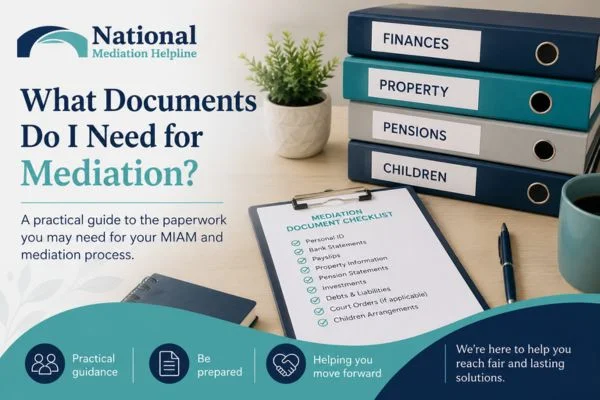
A Simple Mediation Document Checklist
This is a handy starting block if you are getting ready for mediation.
Your first MIAM: any specific court orders or correspondence, as necessary, plus identification/information that the mediation service has specifically asked for
For children mediation: existing arrangements, relevant court orders, school/childcare commitments and other practical information relevant to the issues being discussed.
For financial mediation: bank and savings information, property and mortgage details, income evidence, pension information, investments, debts, business/self-employment information and details of other relevant assets or income.
But remember:
You don’t necessarily need all of this for your first appointment.
Contact the mediation service first, and they can tell you what’s required for your particular case.
What Happens After the Documents Have Been Gathered?
The documents aren’t the end of the process.
They’re the starting point for informed discussions.
Once the relevant information has been exchanged and the financial position is sufficiently clear, mediation can help you explore questions such as:
What happens to the family home?
How should savings be dealt with?
What happens to pensions?
How will debts be managed?
What does each person need to rehouse?
How could different options affect both of you?
Your mediator remains impartial.
They don’t decide the settlement for you, and they don’t act as either person’s solicitor.
Instead, they help structure the conversation and support you in exploring possible solutions.
What Documents Are Needed If I’m Applying for Legal Aid for Mediation?
This is slightly different because eligibility has to be assessed.
The Legal Aid Agency requires an assessment of income and capital for family mediation. Depending on your circumstances, evidence can include wage slips, bank statements, accounts or tax information for self-employment, pension documents, benefit evidence and information about capital.
Ask the mediator exactly what you need to supply rather than relying on a general checklist.
What Documents Do I Need for Mediation? FAQs
Do I need bank statements for my MIAM?
Not necessarily. A MIAM is an initial individual meeting used to discuss your situation and assess whether mediation may be suitable. If you subsequently enter financial mediation, bank and savings information may form part of the financial disclosure process.
How many months of bank statements do I need for mediation?
This can depend on your circumstances and the process being followed. Your mediator should tell you what period of statements is required rather than you guessing and gathering unnecessary paperwork.
Do I need payslips for mediation?
If you’re discussing finances, you may need evidence of your income. If you’re applying for legal aid, specific evidence requirements apply. Current Legal Aid Agency guidance requires appropriate evidence of income and capital.
Do I need pension statements?
If pensions form part of your financial circumstances, you may need to provide relevant pension information. This can include obtaining current pension valuations.
Do I need documents if mediation is only about the children?
You won’t normally need the extensive financial disclosure required for financial mediation. However, relevant court orders and practical information concerning the children’s existing arrangements may be useful.
Should I bring text messages between me and my ex?
Usually, family mediation isn’t about producing every message exchanged during your relationship. If you believe particular communication is relevant, discuss it with your mediator rather than arriving with hundreds of screenshots.
What if my ex-partner hides money?
Both people need sufficient financial information to make informed decisions. If you believe assets or income are being withheld, speak to your mediator and consider getting independent legal advice.
Can the mediator check my ex’s bank account?
A family mediator does not have unrestricted access to either person’s bank accounts. Financial mediation relies upon appropriate financial disclosure by the participants. If disclosure becomes a serious issue, legal advice may be necessary.
Do I need a solicitor as well as a mediator?
A mediator is impartial and does not provide individual legal advice to either participant. You can obtain independent legal advice alongside mediation, particularly when dealing with financial settlements or before formalising proposals.
Do I need to print everything?
Not necessarily. Ask your mediation provider how they prefer documents to be supplied. Many documents are now available electronically.
What if I don’t understand my pension or financial documents?
You don’t need to become a financial expert before attending mediation. Raise anything you don’t understand. Depending on the issue, independent legal, pension, tax or regulated financial advice may also be appropriate.
Can I start mediation before I have all my documents?
Yes, particularly at the MIAM stage. Don’t postpone asking for help simply because you haven’t gathered every piece of paperwork.
Don’t Let the Paperwork Put You Off Mediation
When you’re already dealing with separation, the thought of finding bank statements, pension valuations, mortgage information and court paperwork can feel like one more enormous job.
You don’t have to work everything out before making contact.
The documents you need will depend on:
what you’re trying to resolve, what stage you’ve reached and your individual circumstances.
At National Mediation Helpline, we can help you understand the mediation process and take the next step towards resolving arrangements concerning your children, property or finances.
Not sure where to start?
Speak to National Mediation Helpline today.
You can explain what’s happening, learn more about mediation, and understand the next steps.